Architecture Overview
Hyve H3’s architecture is designed around a clear separation of concerns. By isolating data storage, consensus, and economic security into independent layers, the system achieves high performance and flexibility while maintaining strong cryptoeconomic guarantees. Each layer optimizes for its specific function without compromising the others.
Three-Layer Architecture
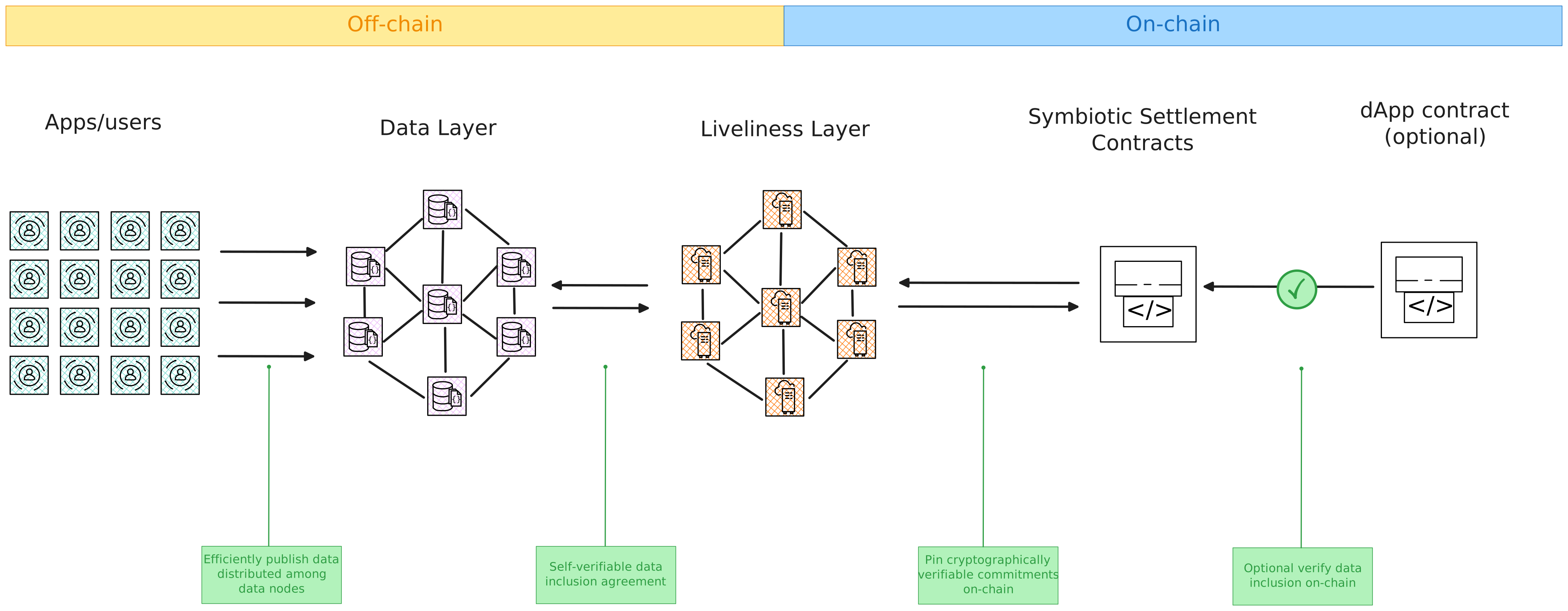
Data Layer
The Data Layer consists of a permissionless set of Data Nodes responsible for ingesting and storing data blobs. These nodes are partially stateless—they don’t participate in consensus and maintain no economic state. Instead, they communicate with the Liveliness Layer to provide availability proofs and coordinate blob inclusion. This design enables horizontal scaling where adding Data Nodes directly increases both storage capacity and ingest throughput without burdening the consensus layer.
Liveliness Layer
The Liveliness Layer operates a high-throughput BFT consensus protocol to agree on blob inclusion and availability. Liveliness Nodes serve dual roles: finalizing which blobs enter the canonical record and continuously auditing Data Nodes to verify they maintain their assigned shares. This layer generates availability certificates that settle on Ethereum, creating a direct link between operational consensus and economic outcomes. The DAG-based consensus design handles high throughput while maintaining sub-second finality.
Economic Layer
Hyve deploys smart contracts on Ethereum through Symbiotic to provide ultimate economic security. These contracts handle staking, slashing, and reward distribution based on availability certificates from the Liveliness Layer. By settling all economic outcomes on Ethereum, the system inherits Ethereum’s security guarantees and finality while maintaining the performance benefits of off-chain operational consensus.
Why Separation Matters
The narrow bridge between layers—where only compact commitments and certificates cross, never raw blob data—prevents consensus from bottlenecking storage throughput. The Data Layer can process gigabytes per second while the Liveliness Layer handles only kilobytes of metadata. This architectural decision enables Hyve to achieve centralized storage performance with decentralized security guarantees.
Security Model
Each layer provides distinct security guarantees tailored to its function:
| Layer | Threat Model | Tolerance | Recovery |
|---|---|---|---|
| Data | Rational + Byzantine | t < n/2 per blob | Erasure coding repair |
| Liveliness | Byzantine | f < N/3 validators | Consensus rollback |
| Economic | Economic attacks | Ethereum security | Slashing enforcement |
The Data Layer tolerates up to half of nodes per blob being unavailable through erasure coding. The Liveliness Layer maintains BFT safety with less than one-third Byzantine validators. The Economic Layer inherits Ethereum’s security model, making attacks economically irrational through slashing.
Performance Characteristics
The architecture’s separation enables different scaling properties for each component:
| Component | Scaling Factor | Bottleneck |
|---|---|---|
| Storage Capacity | Linear with nodes | Hardware limits |
| Write Throughput | Linear with nodes | Network bandwidth |
| Read Throughput | Super-linear | Cache effects |
| Consensus Throughput | Logarithmic | Validator count |
Storage capacity and write throughput scale linearly as Data Nodes join the network. Read throughput achieves super-linear scaling through caching effects where popular data becomes increasingly available. Consensus throughput scales logarithmically with validator count, typical of BFT protocols, but remains decoupled from data volume.